Colombia's new president declares talks with armed groups over
Abelardo de la Espriella was sworn in at Cali under 11,000 troops, saying dialogue is exhausted.
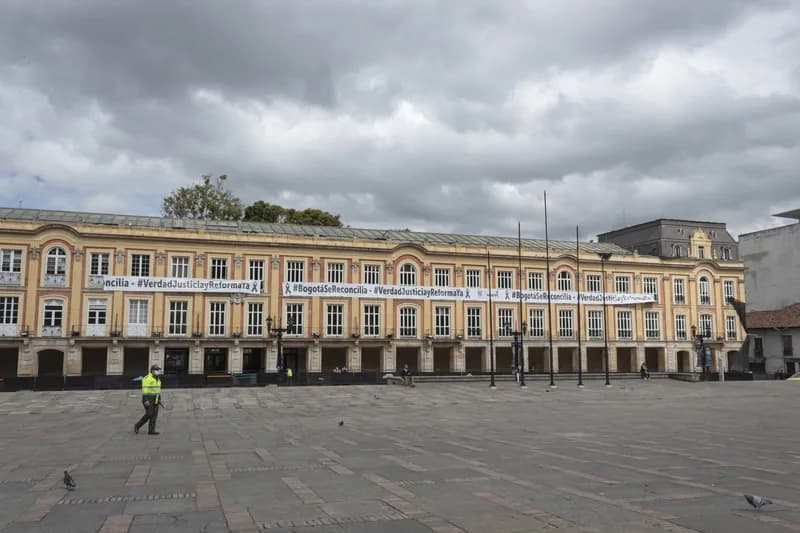
Abelardo de la Espriella was sworn in as president of Colombia on Friday and used his first address to declare the country's experiment in negotiating with its armed groups over. He took the oath not in Bogota but in Cali, a city in the volatile southwest, under the protection of 11,000 troops.
The choice of city was the message. Cali has borne the brunt of Colombia's long conflict, and holding the ceremony there marked a deliberate break from Gustavo Petro, the outgoing leftist president whose policy of seeking peace deals with armed groups de la Espriella has dismissed as a failure.
De la Espriella is 48, a criminal defense lawyer and businessman who has never held elected office and largely paid for his own campaign. Supporters call him El Tigre, the Tiger. He won the June 21 runoff against the left-wing candidate Ivan Cepeda by about 250,000 votes, roughly one percentage point.
There will be no room for maneuvers that undermine the stability of the nation
A ceremony away from the capital
No Colombian president had previously taken office outside the capital. De la Espriella had first wanted to be sworn in on a military base further south, in a region hit hard by the conflict, but volcanic activity nearby made that impossible. Congress approved the move to Cali, handing him an early win.
Security shaped the day. Soldiers and armored vehicles lined the roads near the venue, police screened vehicles for explosives in the days beforehand, drones were banned and private cars were kept off city roads. A government minister had warned of a threat to the ceremony earlier in the week.
The swearing-in took place in a university auditorium in front of Congress, where the new president received the presidential sash from the Senate president, Honorio Henriquez. He then travelled to a nearby army battalion, the Pichincha, to address troops directly.
The guest list read as a statement of alignment. King Felipe VI of Spain attended, along with the acting United States attorney general, Todd Blanche, the FIFA president Gianni Infantino, and the presidents of Argentina and Chile, Javier Milei and Jose Antonio Kast.
The end of Total Peace
Petro's strategy, known as Total Peace, sought negotiated settlements with the many armed groups still operating in Colombia. Critics say it failed, and that some groups used the ceasefires they were granted to rearm, regroup and widen their control over rural communities.
De la Espriella intends to replace talks with force. He has said he will build large prisons, and revive aerial spraying and the use of drones to destroy coca crops, a practice Colombia abandoned more than a decade ago over environmental concerns.
He has given armed groups 100 days from the start of his administration to surrender. In his address he pledged to relentlessly defeat narcoterrorism and said the option of dialogue was completely exhausted, language that leaves little room for the negotiations his predecessor spent four years pursuing.
The groups in question are not few. Colombia's southwest is contested by dissident factions of the FARC who rejected the peace deal the movement signed a decade ago, by the Clan del Golfo drug cartel, and by the National Liberation Army, known as the ELN.
We're talking about a conflict that has an estimated 27,000 individuals involved in different armed and criminal groups
Dickinson said the pendulum has swung back to the right after four years in which negotiations produced little, and that heavier military pressure could weaken the groups and push some fighters to demobilize. She also warned that closing off talks entirely could be counterproductive, and said those individuals will need a route back into normal life.
Washington moves closer
De la Espriella has said Colombia will join the Shield of the Americas, a United States backed regional bloc against drug trafficking that grew out of a summit hosted by the Trump administration in March. He has proposed running Colombia's part of it from Medellin rather than the capital.
His incoming defense minister met the United States assistant secretary of defense in July, and a US assistant secretary of defense then announced the two countries would work together on a security initiative named after a strategy used in the 2000s. He is also expected to speed up extraditions of rebel leaders wanted in the United States on drug charges.
As a cornerstone of this renewed partnership, the United States, working with Congress, intends to announce $1 billion in assistance as part of a security package to support President de la Espriella's Administration in achieving our shared goals
Trump endorsed de la Espriella's campaign personally. The new president has also backed the American campaign of military strikes on vessels suspected of carrying drugs in the Caribbean and eastern Pacific, in which more than 200 people have been killed, according to the Washington Office on Latin America.
Diplomacy and money
On foreign policy he has promised a rearrangement rather than simply a retreat. De la Espriella has said he will sever diplomatic relations with Cuba and Nicaragua, describing both as tyrannies and saying there will be no ties whatsoever with them, while restoring other relationships that Petro had broken off.
He also plans to close 14 Colombian embassies, mainly in Europe, Africa and the Caribbean, and 15 consulates that have not yet been named. His government has proposed a technical audit of embassies and consulates to decide whether more should go.
| Relations with Cuba and Nicaragua | Severed |
| Embassies to close | 14, mainly in Europe, Africa and the Caribbean |
| Consulates to close | 15, not yet identified |
| Government spending | Cut by as much as 40 percent |
| Deadline for armed groups to surrender | 100 days |
As filed
The money saved on missions is meant to go to security and public investment. Separately, De la Espriella has said he wants to cut government spending by as much as 40 percent to close a budget deficit that doubled under Petro, and to revive Colombia's oil and gas industry.
The constraints
His difficulty is arithmetic. The party he campaigned under holds one seat in the Chamber of Representatives and four in the Senate. He has built an alliance with Alvaro Uribe's Democratic Center, the Conservatives, Radical Change and We Believe, and even together they fall short of a majority.
The coalition has already shown its limits. De la Espriella's choice for Senate president lost to a candidate from the Democratic Center, one of his own allies, who picked up votes from Petro's bloc. He responded that he respects the autonomy of Congress and the independence of the branches of government.
Petro also leaves loudly. He initially refused to accept the result and alleged the vote count had been manipulated, a claim rejected by international observers and by Colombia's own electoral authorities. NPR reported on Friday that he had still not acknowledged the result; Al Jazeera reported that he ultimately said he would respect it.
The streets
Protests broke out in Cali, Bogota and Barranquilla on inauguration day. In Cali's Puerto Resistencia neighbourhood, the center of mass demonstrations in 2021, a 25 year old protester was quoted in the Al Jazeera report saying residents were defending dignity against a president who had not won their support. He has 100 days before his first deadline falls due.
Sources for this article
3 sources
- 1NPR, Colombia's new president vows to remake the country and challenge its fragile peacestatementBy Manuel Rueda, 7 August 2026
- 2Al Jazeera, De la Espriella sworn in as Colombia's leader, vows armed group crackdownstatementAFP, AP and Reuters, 8 August 2026, source of the inaugural address quotes
- 3AS/COA, Ahead of Inauguration, Colombia's De la Espriella Sets AgendadocumentBy Chase Harrison, 5 August 2026, updated 6 August
More from Threadline News
 BusinessSweetgreen cuts 2026 sales outlook on cyclospora outbreak fears7 Aug 2026
 PoliticsTrump narrows birthright citizenship in two new orders7 Aug 2026
 HealthHead Start rule strips federal standards and adds new mandates7 Aug 2026
 EntertainmentParamount and Warner Bros merger heads to trial in March 20277 Aug 2026
 BusinessGreenhouse says 2,539 people apply for every 10 job openings7 Aug 2026
 PoliticsOhio's two GOP senators urge Max Miller to resign7 Aug 2026
The Numbers
AllOfficial series, each dated to the month it covers.
Federal Reserve Bank of St. Louis